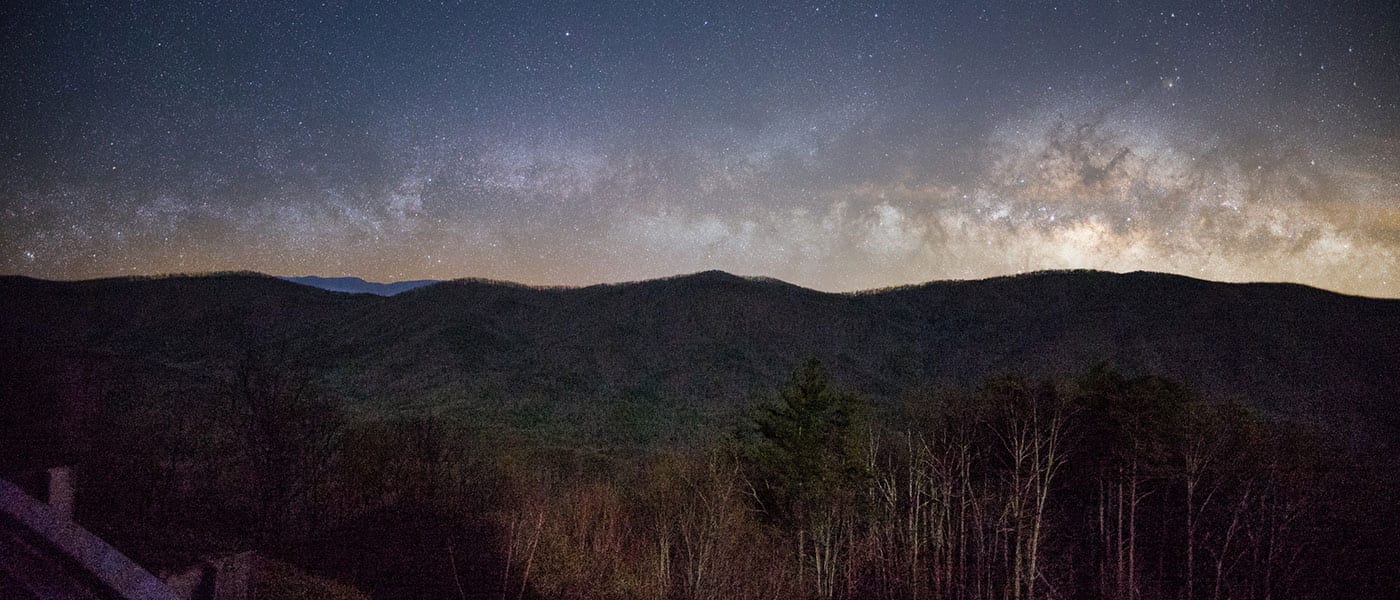
The thing about living here is that you forget. You carry the groceries in from the car, the porch light is on, the dog wants out, you're thinking about dinner. Then one night in November you happen to step out to the driveway without the porch light, and you glance up, and the sky stops you where you stand.
You remember, every time, that you live under one of the best skies in the state.
Gilmer County isn't Cherry Log dark, and it isn't Cohutta-Wilderness-at-three-miles-from-a-road dark. But it's plenty dark enough. On a new moon, with the porch light off and the ridgeline blocking the last of the glow from any of the little towns below, the Milky Way comes across the sky in a band you can see without trying. The dark between the stars has a texture. Shooting stars come often enough that you stop pointing them out after the second one. It's the sky human beings saw for ninety-nine percent of human history, and most places have lost it, and we didn't.
Different seasons give you different versions of it.
Summer is the show. The core of the Milky Way rises in the southeast and climbs up over the ridges, and by July it's sitting high overhead by the time the fireflies have quit. If you've never looked at that core through a decent pair of binoculars, it's worth borrowing a pair. The haze resolves into thousands of individual stars stacked deep into the galaxy, and you can see the dark lanes of dust running through it, and you lose twenty minutes without noticing. The Perseid meteor shower peaks in the second week of August, and a good Perseid night in a field off one of the county roads will put sixty meteors an hour past your eyes if you're patient.
Fall is the quietest season for it. The summer crowds are gone, the winter cold hasn't set in, and the air has dried out enough to sharpen every star by half a magnitude. The Orionid shower comes through in late October. The leaves are coming down from the hardwoods, which matters more than people think — by November you can see through ridgelines that were a green wall in July.
Winter is the sleeper. Everybody assumes summer, but the coldest, clearest nights of the year are in December and January, and that's when the big winter constellations are out. Orion standing up over the trees. Sirius blue-white at his feet. The Pleiades tight and bright overhead. The Geminids in mid-December are the best meteor shower of the year if the weather cooperates, and they often do, because the same cold front that clears the air gives you a black sky from dusk to dawn. Grab a lawn chair, a blanket, a thermos of whatever you drink at night, and you've got an hour before the cold wins.